Final Paper

           Homer’s famous epic poem, “Iliad”,  portrays the war between Greek and Troy, with many heroes— such as Agamemnon, Achilles, and Odysseus—appeared. Though these heroes’ stories are elaborated, certain hero’s role is neglected by Home: Menelaus is the greatest example, as Home barely described him in the fighting part even he is a steady fighter. Why homer makes Menelaus become “peripheral” in Iliad? After doing a detailed investigation, I believe that Homer wants to shape Menelaus into a character whose roles lay on a deeper level both to other characters in the Trojan War and to the audience. While Menelaus’s certain role, such as starting the war, is explicitly important in the Trojan War, he also plays some implicitly important roles that others don’t play, such as acting as a reflection/sign, a moral figure, and a connection of the war. This essay is going to explore both the explicit roles and implicit roles played by Menelaus in the Trojan war.

           Some people may wonder who Menelaus is? Menelaus is the younger brother of Agamemnon who is the high king of the Mycenae and the commander of the Trojan War. He is the husband of Helen who is the direct cause of the Trojan War. He is the king of  Sparta, where Helen’s father once ruled.  He is also a brave and steady warrior who fights for Greeks without hesitation, though this characteristic is not as obvious as that is reflected on Achilles in the Iliad.

            Menelaus’s first role is obvious: He is the launcher of the Trojan War. Previous to the content of the Iliad, Prince Paris from Troy stole Helen, Menelaus’s wife, from Greek. After realizing the betrayal of his wife, angry Menelaus convinced his brother Agamemnon to wage war toward Troy. The origin of the Trojan war then starts from Menelaus.  However, Menelaus’s action plays another special role: it reflects a special Kleos ( Honor ) —the Kleos regarding family. In Greek, males view Kleos as the final thing they need to get even by going to die. I believe that the perfection and the integrity of the family belong to a part of a man’s Kleos. That a man can’t ensure the integrity of his house means that the man is useless, unattractive, and laughable, all of which are characteristics opposite to Kleos. Because Menelaus could not bear with such humiliation, he waged the Trojan war. Throughout the Trojan War, all other warriors’ Kleos center from killing enemies, while only Menelaus reflects both family Kleos issue and fighting Kleos. One thing to mention, although Agamemnon also received betrayal from his wife, it happens after the end of the Trojan war.

           Besides, Menelaus actually contributes to the start and the success of the war from another aspect. When Menelaus was chosen to become the husband of Helen, he received a present from Helen’s father: that all other suitors should help and protect the husband of Helen at any cost, and should promise not to wage war against him. All other suitors agreed. Because of this agreement, powerful warriors such as Odysseus and Diomedes, along with their armies, join the expedition. Such powerful strength would make Greek’s success even more possible. In fact, for instance, if Odysseus hadn’t joined the Trojan War and hadn’t created the Trojan horse that can contain the army within its body, Greeks would not have sacked Troy that easily. Diomedes, under the help of Athena, killed dozens of Trojan heroes while also hurting the goddess Aphrodite who stands on the Trojans’ side. All of these contribute to the defeat of Troy. All of these reinforcements bring confidence to Menelaus and Agamemnon to launch the war.

           In Iliad, Homer let Menelaus play a role more like a mediator of the war rather than a revenger who launch the war, as reflected in the duel between Menelaus and Paris. Specifically, Menelaus says, “I deem that the parting of Achaeans and Trojans is at hand, as well it may be, seeing how much have suffered for my quarrel with Alexandra’s and the wrong he did me. Let him who shall die, die, and let the others fight no more.”(Book 3) Menelaus is trying to solve the problem personally by only killing Paris through a duel instead of expanding the revenge action into a war. Menelaus is not a zealot of the war. I believe no one wants thousands of innocent people to die merely because of his issue with another person. At this time, Menelaus is more like a simple husband who merely wants to kill his wife’s lover.

           However, the mediator role played by Menelaus is dimmed by so many elements. First, the gods’ interference makes his role become inferior. In essence, gods like Athena want the war to happen, so she templates Pandarus, a Trojan soldier, to shoot Menelaus to break the peace agreement. At the same time, Aphrodite, the goddess of love, prevents Menelaus from killing Paris, breaking the fairness of the duel. Second, most importantly, I believe all other Greeks warriors, even some of them feel terrified about the war before it happens, want to fight when the war actually begins. Even homer directly says, “both sides want the war to stop”, his descriptions of Greek warriors contradict with such will. The Achaeans sailing for Troy is similar to the gathering of ignited powder kegs that cannot be stopped. In Book 3, Homer says “Greek archers and slingers were taking aim at Hector and already starting to shoot arrows and stones when Agamemnon boomed out a command to hold fire.” This happened when Hector went out of Troy. Soldiers are supposed to listen to their commander’s order before starting a new wave of attack. However, the immediate attack shows Greek warriors’ passions to fight. In book 5, that Homers describes Soldiers as “stand tight without a flinch, as always” and “met Trojans without a tremor” shows Greek warriors’ readiness to fight. More importantly, Greek heroes also want to fight: Idomeneus, an advisor to Agamemnon and a courageous warrior says “there man’s courage is best decided, where the man who is a coward and the brave man show themselves clearly; the skin of coward changes color one way and another, and the heart inside him has no control to make him sit steady, but the brave man’s skin will not change color, nor is he too much frightened.” He is arguing that the war is the place to distinguish a brave man from coward, to bring honor to the right person. The passion for proving braveness and for getting honor makes these heroes actively engage in the Trojan War for ten years. In other words, the Greeks could not allow themselves to go home without any achievement. Consequently, no matter the duel happened or not, they would keep fighting till the end. Because of these beliefs, Menelaus’s role as a mediator of the war becomes even more inferior.

           However, Because of the honor issue I mentioned above, I believe Menelaus’s role and the duel can be interpreted in another perspective: that Menelaus accepts the duel with Paris accidentally becomes the catalyzer of a more barbarous war and connect Greeks army and the Trojan war together. Previously, Greeks warriors may not have a personal connection with the war. Even Agamemnon’s aim is merely to revenge for his younger brother. However, when the Trojan side breaks the temporary peace agreement by shooting Menelaus, though manipulated by gods, Greeks will have a feeling of being offended. Suppose you are a soldier of county A and your county is having a war with country B. Two countries have reached a peace agreement. Suddenly, an assassin from B tries to kill your commander. What is your feeling? You must feel that your country has been humiliated as if country A is the weaker one that is naive and believes in peaceful agreement. With this feeling in mind, you will notice that the Greeks must be angry and are willing to make Trojans pay for their arrogance. Indeed, Agamemnon soon says “be man, my friends. Fight with valor and with a sense of shame before your comrades” (book 5) to encourage the army to fight more fiercely, for no Greek can bear with this offense. In short, Menelaus’s duel with Paris actually marks the official start of the Trojan war, with Greek warrior have a more personal connection with the war.

           During the fight, Homer describes Menelaus more like a younger brother of Agamemnon and a moral figure that bring morale to other soldiers. The role of Menelaus officially turns into implicit. There is an article exploring the role of Menelaus in the Trojan War, while also analyzing the interaction and relationship between Agamemnon and Menelaus. According to Sammon, “Menelaus is more like a moral figurehead of the Achaean expedition, while Agamemnon acts as an army commander in chief.” (Sammon, 2009) Specifically, after Menelaus has convinced Agamemnon to conquer Troy, he seems to cede all authority over the expedition to his brother. He is not a member of Agamemnon’s inner council of foremost heroes, including Ajax and Diomedes. He also never speaks in the assembly where Agamemnon exercises his authority publicly. They seem to have no interaction. However, book 10 of the Iliad, according to the author, indicates that there are interactions that reveal the relationship between Agamemnon and Menelaus. First, that Menelaus wears a leopard skin while Agamemnon wears a lion skin shows that Menelaus is inferior to Agamemnon. Second, when both Agamemnon and Menelaus showed the feeling of terrified toward the conquer of the Troy, Nestor blamed Menelaus as a coward while praising Agamemnon as a wise man who considers every situation possible. It further indicates the inferiority of Menelaus. I realize that the role of Menelaus in the Trojan War is manipulated by Agamemnon instead of by Menelaus his own. Because Menelaus has already become a victim whose wife has been robbed by others, Agamemnon wants to use this characteristic of Menelaus as a tool to raise other heroes’ resentments and morale. It is similar to such a situation: by portraying a beggar as vulnerable and helpless, everyone will have sympathy toward him and is willing to help the beggar. This is the reason why Agamemnon delivers a lament speech to the public after seeing that Menelaus has been shot by Pandarus, a trojan. In order to maintain Menelaus’s identity as a victim, Agamemnon tries to push Menelaus back every time he wants to fight. Besides, through the conflict between Agamemnon and Achilles, we can know that Agamemnon is a person who favors absolute power. Consequently, Agamemnon will not allow Menelaus, his brother, to have the same status as him. The absence of Menelaus in most scenes is not because Menelaus is a coward, but because he is forced to be shaped as a coward by Agamemnon. The manipulation of Menelaus’s pubic image also indicates Menelaus’s younger brother role: that, as a younger brother, he should discuss everything with his older brother privately before putting it in front of public, while also should obey his older brother’s command. This article is significant because it explores deeply into the Agamemnon-and-Menelaus relationship that the book Iliad does not obviously state. It also explains the role of Menelaus plays in the Trojan War, as a younger brother and a moral figure. I realize that the bond between the brothers in the ancient Greek society is not that friendly and tight as I think. Besides, the warrior code that focuses on honor manipulates everyone’s behaviors at that time. Going back to the broader view, Menelaus’s function here is more implicit.

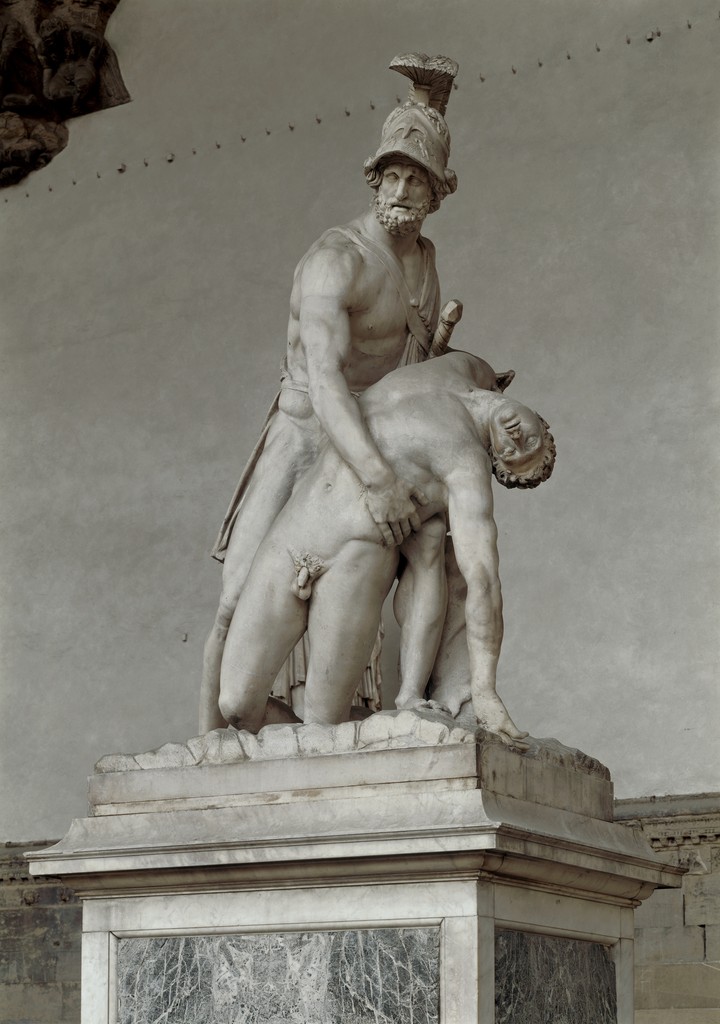
           In book 17, that Homer let Menelaus become the defender of Patroclus corpse also has its won meaning: connecting the Trojan War and Achilles, the main fighter who contributes to Greek’s success, together. Strelow’s article tries to fully explain the role and character of Menelaus in book 17. In book 17, Menelaus is the first man noticing the death of Patroclus. As soon as he discovered it, he killed all the enemies who want to take Patroclus’s body, while asking Antilochos to bring news of Patroclus’s death to Achilles. Menelaus decides to return to the war zone instead of going with Antilochos. According to the article, Menelaus does this because of sympathy instead of glory, as Menelaus says the words like” painful message” and book 17 described him as” reluctant to leave.” Why homer singled out Menelaus for such extraordinary prominence? According to the author, there are two theories explaining this. The first explanation is that Menelaus is the only choice because other heroes, such as Ajax and Odyssey, are wounded. However, this does not explain why Aias is not chosen. The second explanation is because Patroclus and Menelaus are similarly gentle. Nevertheless, it fails to explain the central role played by Menelaus in this pivotal area. There is also an explanation saying that the ancient author likes to draw similar motifs from other poems: that Patroclus’s body is defended by Menelaus and Aias is similar to Achilles’s body is defended by Odyssey and Ajax in Aithiopis; It is a mere focus of certain character. All of these, according to the article, does not address the problem. In the author’s opinion, “Menelaus fulfills a pivotal function in mediating the two major themes of the poem: Achilles’s wrath and the Trojan War.”(Stelow, 2003) Menelaus is the central cause of this war and has an overriding concern about the prosecution of the war. However, Achilles has no reason to join this war previously until the death of Patroclus. By letting Menelaus defending the corpse of Patroclus, Homer draw Menelaus into Achilles’s story. Why that works? In my understanding, first: Patroclus is Achilles’s best friend so Achilles must value him deeply. Second, in Ancient Greek culture, if a warrior is killed, his complete corpse should be brought back to his homeland so that his family members or even citizens can bury him and lament for him. It’s another way to attain Kleos for that warrior.  Combining these two reasons, that Menelaus defends the corpse of Patroclus means to preserve the honor of Patroclus and to respect Achilles as a friend, making Achilles feel moved. Consequently, Menelaus’s action plants the seed of Achilles’s decision to join the war. Two heroes who have different motives are now struggling toward the same outcome: conquering the Troy. The article is unique because it tells us that the chosen of Menelaus is not a random selection; it has its purpose, which is connecting two main themes of the Iliad. It explores one scene that one usually doesn’t care too much about, with innovative and persuasive reasons. In addition, I believe that protecting ally’s corpse is exceptionally important and that Patroclus’s body is defended by many heroes with high cost is one of the few unique cases. In conclusion, the role of Menelaus here is important in an implicit way.

           In conclusion, Menelaus’s role is really contradictory in the Trojan War. He starts the war for a personal family issue. However, he later tries to mediate the war by having a duel with Paris while he seems to disappear in the latter part of the war. Nevertheless, it is just during this time that his role of importance turns from explicit to implicit. I believe Homer has his own purpose when describing Menelaus’s role. For example, he wants to use all other characters to reflect the main characters: Achilles, Agamemnon, and Hector. Consequently, Menelaus is more like a sign and a connection to the war.

Homer(N/A). Iliad.

Sammons, B. (2009). BROTHERS IN THE NIGHT: AGAMEMNON & MENELAUS IN. BOOK10. OF THE ILIAD. CLASSICAL BULLETIN85(1), 27–47.

Stelow, A. (2003). The “Aristeia” of Menelaos. THE CLASSICAL JOURNAL104(3), 193–205. published in March.2009
Response to book12 Q3

On island Thrinakia, When Odysseus prayed to gods to show the way out after Odysseus’s team ran out of food, gods did nothing but let him fall into sleep during which his crew killed cattle that are not allowed to be killed. They are now going to receive punishment. Odysseus blamed gods for being ruthless and for making him unable to supervise his crew. In my opinion, it’s not the gods’ fault. First, it is because that the crew has low self-restriction ability. If they had resisted starving for a longer time, they would have reached home safely. The crews are adults and warriors; they ought to keep the promise themselves instead of letting Odysseus supervise every action for them. Besides, god cannot control everything. Just as Zeus “can’t” save his son Sarpedon, gods can’t stop the crew from reaching their destiny: death. Finally, Odysseus may fell into sleep just because he was too tired, as he had just passed Scylla’s and Charybdis’s cliffs. God may not manipulate Odysseus’s actions.

Response to the reading

I do believe that “toxic heroism” will cause citizens to seek for honors at any cost and to engage in destructive behavior toward society or themselves if their personal honors are unrealized or underestimated. For instance, in the book “Ajax,” Ajax tried to kill all the Greek army simply because he didn’t get Achilles’s armor—the symbol of honor. In the book “Iliad,” Achilles prayed to the god hoping his people, Greece, to die simply because Agamemnon deprived most of his honor and humiliated him. Hector would have escaped from death by going back to his city Troy if he hadn’t become crazy about protecting his honor.
In addition, toxic heroism is reinforced by both the social culture problem and self-restraint problems. The ancient Greek culture focuses too much on hero-like behaviors, which include negative behaviors such as killing—the symbol of courage and warrior-like spirit. Consequently, it hurts society’s development by asking everyone to pursue the toxic heroism culture. On the other hand, about the self-restraint problem: in the “Ajax”, Ajax could not resist the anger caused by the fact that Ajax didn’t get the armor of Achilles, leading to his misbehavior of slaughtering his “allies” and later his commitment of suicide.
Besides, I agree that toxic heroism isolates certain groups of people. Women are clearly discriminated against because they neither can do hero-like behaviors such as fighting nor can they have a hero-like characteristic such as emotionless. For example, in Greek, women are the awards or spoils for the man warriors: In “Iliad,” Agamemnon chose the woman robbed from the conquered city. In “Ajax”, Ajax’s wife Tecmessa was robbed by Greece from her hometown Troy.
In modern society, certain people still pursue toxic heroism culture. For instance, the show “The Mask You Live In” indicates that boys from American primary school generally think that they are not supposed to cry, or they will be considered as cowards. Besides, they also believe that beat or fight with other boys are an important way to show their powers. Even such behaviors have no connection with heroes, those children believe they have. In more extreme cases, as mentioned in the passage, certain people commit massacre in order to show their heroic characteristics. Why? According to the author, it is because the individualism culture of the US makes people to focus too much on personal achievement. Consequently, if some people don’t have harsh control over themselves, and if they notice that their privilege has been deprived, they will engage in disastrous behaviors.

Response to question 8

Hector denies his wife Andromache’s plead of staying at home with the family by saying that he has to fight in the frontline of the war for both himself and other warriors. First, Hector says that he will not see the slavery of Andromache–which would make him feel exceptionally painful–if the trojan warriors lose the battle and he dies on the front-line of the battle. To Hector, fighting with the Greeks rather than staying at home is a release. Second, Hector says that he has gotten used to fighting in troy’s first ranks. If he decides to back up, he will lose both his and his father’s honor that a warrior values because others will consider him as a coward and think that Hector’s father has a weak son. Hector’s self-esteem makes him enable to endure such humiliation.. Third, he appreciates his warriors’ effort of fighting outside the Troy. He also knows that those warriors have family members who extremely cherish those warriors. If he himself retreats, it is a betray of his warriors and their family members. Consequently, Hector has to fight with his warriors.

From the perspective of a husband, what Hector does is selfish and morally wrong because he ignores his wife’s need for him. From the perspective of a father, Hector’s behavior is also selfish and morally wrong because he gives up the chance of raising his young baby who needs the father’s love the most. However, from the perspective of a warrior and a citizen, what he does is selfless and morally right because he gives up his own family and decides to contribute to his country and fight with other warriors.

In Homer’s world, men’s fundamental value is centered around country. They think that the honor, the safety of the country, and the courage in the war are fundamental values for them. They think that protect the country and get the honor with any cost is the good thing for the society. However, women’s fundamental values start from a totally different perspective: their values center around family. To women, that all family members are safe and satisfied, that everyone lives in a simple normal life, and that everyone cares about each other are the most important values for them. They think that staying with the family until the end of lives is good for society.

Essay of the theme

Nostos is a Greek word knowing as homecoming. It represents the returning-home trip, usually by sea, of a warrior who fights on foreign land. Nostos is an important theme appearing in most Greek literature. It is also an important and complex practice in Ancient Greek society. Greeks view the homecoming journey as the final test for a hero in the war. Consequently, the trip is not that easy: it usually involves scenes like a shipwreck, an interference from gods, or getting lost. For example, gods let Menelaus lose the trial and let him wander in Egypt for several years before returning home because he did not offer sacrifice to gods who want human’s respect and attention all the time. If the hero overcomes all the difficulties during the trip and manages to return home, he then can successfully prove his greatness and abilities. The completion of the journey is another sign of glory, which Greeks emphasize. However, for those heroes who failed to return safely, the results are often tragic. For instance, Athena made Little Ajax fall to death near the shore of an Island because he did not respect her; Agamemnon was killed by Aegisthus, the secret lover of Agamemnon’s wife Clytemnestra, when Agamemnon hasn’t reached home. In general, the return is not just about physically returning home, but about retaining a hero’s identity, status, and property upon arrival.
In the book Odyssey, Nostos is one of the main themes of the book. It happened to many heroes in the book— Nestor, Menelaus, and Odysseus— in different ways. Besides, the story is either told by heroes themselves who experienced Nostos or by others who may or may not see the process. When Telemachus, son of Odysseus, went visiting Nestor to find the trail of Odysseus, Telemachus knew the nostos of Nestor from Nestor’s recall: Nestors acquired the god’s sign that told him the right direction, and he safely reached his homeland. It is a perfect Nostos with no real issue. Telemachus also learned from Nestor that Little Ajax failed his Nostos and died on an island. When Telemachus went visiting Menelaus, he also learned about Menelaus’s Nostos: Menelaus was punished by gods and lost the direction because he didn’t give sacrifice to gods to show his respect. He wandered around Egypt for several years until he met a goddess who told him the reason for his suffering and how to end it. From the goddess, he also learned that Odysseus was trapped in an island. Menelaus then gave sacrifice to god to appease the gods’ anger, and he finally reached home. It’s a Nostos with mild suffering. The main character Odysseus’s Nostos, is the hardest. According to his later recall and Menelaus’s hearing, Odysseus’s team first met goddess Circe who turned most sailors into pigs. Later, Odysseus’s ship collapsed near the shore of Island Ogygia. He was the only person alive at that time. The owner of the island, goddess Calypso fell in love with Odysseus and did not want to let him leave. Consequently, Odysseus was trapped by Calypso on the island for seven years. When he left the island and was about to reach the land, god Poseidon created a strong wave that almost killed him. It’s a Nostos with lots of suffering.
While Odysseus was far away, his love for his family and home motivates him to seek ways to reach home, to complete his Nostos safely. He kept watching in the direction of his home when staying on the island. Even he could become eternal by staying with goddess Calypso, his longing to go home remains as a strong desire.
The book Odyssey is going to tell what Odysseus is going to do after he finished his Nostos. One unresolved problem is how to deal with those suitors that robbed the possession of Odysseus. It is a new journey of restoring a hero’s identity and property, a journey that accompanies the theme of Nostos.

Brill’s new Pauly [electronic resource]. (2005). Leiden: Brill.

Cannon, M. (2002). Concepts and Themes: A Learning Odyssey. Gifted Child Today, 25(3), 24–29. https://doi.org/10.4219/gct-2002-72

Dupriez, B., & Halsall, A. (1991). A dictionary of literary devices : gradus, A-Z / Bernard Dupriez ; translated and adapted by Albert W. Halsall. Toronto, [Canada] ;: University of Toronto Press.

Spawforth, A., Eidinow, E., & Hornblower, S. (2012). The Oxford classical dictionary (4th ed. / general editors, Simon Hornblower and Antony Spawforth assistant editor, Esther Eidinow.). Oxford: Oxford University Press.

Thornton, A. (1970). People and themes in Homer’s Odyssey. Dunedin: University of Otago Press in association with Methuen, London.

Theme’s Bibliography 2

Source 1: Montiglio, S. (2003). Odysseus’ return and the memory of wandering. Gaia : revue interdisciplinaire.  sur la Grèce Archaïque, 7(1), 215–223. https://doi.org/10.3406/gaia.2003.1417

The article talks about one part of Nostos: wandering. It says that to wander means to be human, as immortal creatures won’t suffer from this process. Besides, it talks about how the goddess Circe helped Odysseus find the direction of home and how Odysseus managed to finish his nostos with his own struggle. I learned that the process and the result of nostos are deeply affected by gods and warriors themselves. First, it’s gods who manipulate human nostos. Gods can be an obstacle in a person’s Nostos. If gods feel unsatisfied about a person who might contradict the gods’ wills, gods will make that person’s nostos long and suffering. For example, because Menelaus did not give sacrifice to gods, they make him wander around Egypt for a decade. However, gods can also be an accelerator in a person’s Nostos. The article mentions that the goddess Circe converted Odysseus wandering to a directed journey by giving him a map, asking him to visit Hades, and suggesting him not to pass the Wandering Rock. Gods have the most significant influence on Odysseus’s Nostos: Calypso trapped him; Poseidon punished him; Circe helped him, and Helios penalized him. Besides the gods, the warrior’s perseverance also contributes to his success in returning home. Specifically, a wandering warrior has to resist different kinds of temptations while keep remembering his goal of going home, or he will keep wandering and may even die. Besides, a warrior must obey the gods’ suggestions or rules to avoid tragedy ends. Because Odysseus’s unfailing memory of returning home, he saved his companions from Lotus-Eaters. Because Odysseus followed Circe’s advice, he overcame many difficulties. However, because his companions ate the cattle that are not allowed to be eaten, they all died on the ocean later. In fact, I believe Odysseus became the only person alive just because he resisted the temptation for food. All of these taught Odysseus that he should never forget his goal and past wandering if he wanted to go home and see his dear family members. With this belief in mind, he even resisted the temptation of becoming immortal with goddess Calypso, and finally started the journey toward home successfully.

Source 2: NAGY, G. (2013). The Return of Odysseus in the Homeric Odyssey. In The Ancient Greek Hero in 24. Hours (pp. 275-295). CAMBRIDGE, MASSACHUSETTS; LONDON, ENGLAND: Harvard University Press. Retrieved April 4, 2020, from http://www.jstor.org/stable/j.ctvjghtrn.14

The article explores the meaning and role of Nostos in Odyssey. Specifically, it says that Nostos is not just a term meaning homecoming, but is a song that can record the Kleos(honor) of warriors and bring feelings to others. I learned that Odysseus’s nostos means more to him than that Achilles’ Nostos means to himself. For Achilles, Homer has shaped him into a central hero of the story of Troy. Even he died on foreign land and failed to destroy Troy; he won Kleos by killing Hector. Achilles used his death to exchange for the victory of Greeks and his honor. In comparison, Kleos of Odysseus at Troy was preempted by the Kleos of Achilles. Odysseus cannot afford to dwell on his success at Troy because his Kleos would only become permanent if he achieved a successful homecoming and tell the story to others. It’s a setting appearing in the book Odyssey. Besides, Odysseus’s nostos is meaningful to many other people, especially to Telemachus and Penelope. “The nostos of Odysseus is defined by the quest of his son Telemachus to learn the identity of his father, thus to learn his own identity.” The understanding of his father’s nostos, which is equivalent to Kleos in this case, will help Telemachus know what kind of person he should be, and how proud he should feel about his father. The nostos of Odysseus makes Penelope feel grief because she believes that Odysseus has dead. To show this grief, Homer describes Penelope as tearful when hearing the Achaean’ homecoming song performed by Phemios. Indeed, the failure of Odysseus nostos will mean that Penelope would lose an intelligent and powerful husband she loves and that Penelope would be forced to marry a suitor who is surely arrogant and is enjoying robbing Odysseus possession. Before Odysseus had returned home, his nostos would seem like a painful song that makes most of the people depressed. When he had returned, his nostos would then become a song of honor and happiness.

Source 3: Alexopoulou, M. (2009). The theme of returning home in ancient Greek literature : the nostos of the. epic heroes / Marigo Alexopoulou ; with a foreword by Vayos Liapis. Lewiston, N.Y: Edwin Mellen Press.

From this article, I first learned that the nostos of Odysseus is much more dramatized and complexed than most of the heroes’ nostos. For example, Odysseus wandered much longer than any other hero. He met more diverse difficulties relating to gods, humans, and nature. He needs to handle more problems at home after reaching his homeland as he has a “suitors problem.” Still, he is the lucky one because he is alive after suffering a lot, while poor Agamemnon and Little Ajax met their destiny of death. Moreover, this article further extends the meaning of Odysseus’s nostos. It says that a warrior will finish his nostos if he has retained all his previous states instead of merely reaching the homeland physically. Those states, including status, recognition, property, and relationship. The external nostos has now become internal nostos. According to the article, one important method to finish nostos is Disguise. Because the long time absence of Odysseus can change the lives of loyal members in his house, Odyssey has to disguise in order to ensure that they recognize him genuinely, not physically. By disguising as a stranger and asking them questions, Odysseus can get the real answer.  Besides, because Odysseus has known that Agamemnon openly returned home and was killed by his wife and her adulterer, Odysseus fears that his wife Penelope will also betray him. Besides, Athena told him that Penelope did not refuse any suitors’ proposal, but she acknowledged that one day she would marry one of them. Consequently, he also has to disguise and test his wife’s loyalty. All of these behaviors are aiming to restore people’s recognition toward him, which is part of the internal nostos mission. Finally, disguise can help Odysseus kill those arrogant suitors who want to kill Telemachus, robbed Odysseus’s property, and humiliated Odysseus. I realize that taking revenge toward suitors is also important for Odysseus’s nostos because it relates to recovering Odysseus’s property and honor that are included in internal nostos.

Source 4: Bonifazi, A. (2009). Inquiring into Nostos and Its Cognates. The American Journal of Philology, 130(4), 481-510. Retrieved April 4, 2020, from http://www.jstor.org/stable/20616206

Source 5: HALLER, B. (2013). Dolios in “Odyssey” 4 and 24: Penelope’s Plotting and Alternative Narratives of. Odysseus’s νόστος. Transactions of the American Philological Association (1974-2014), 143(2), 263-292. Retrieved April 4, 2020, from www.jstor.org/stable/43830263

Source 6: Katz, M. (1991). COMING HOME/GOING HOME (BOOKS 13, 15, 16). In Penelope’s Renown: Meaning.  and Indeterminacy in the Odyssey (pp. 54-76). PRINCETON, NEW JERSEY: Princeton University Press. doi:10.2307/j.ctt7zv6gr.7

Imagery Gallery

图片包含 室内, 花瓶, 舰, 餐桌

描述已自动生成

Title: Attic black-figured amphora B

Original: Athens 

Creators: Attributed to the Painter of the Vatican Mourner (or Painter of Vatican)

Date: 530 BCE

Current Place: Vulci, Etruria Rome, Vatican Museums, Museo Gregoriano Etrusco

Work Type: Ceramic

Material: Terracotta

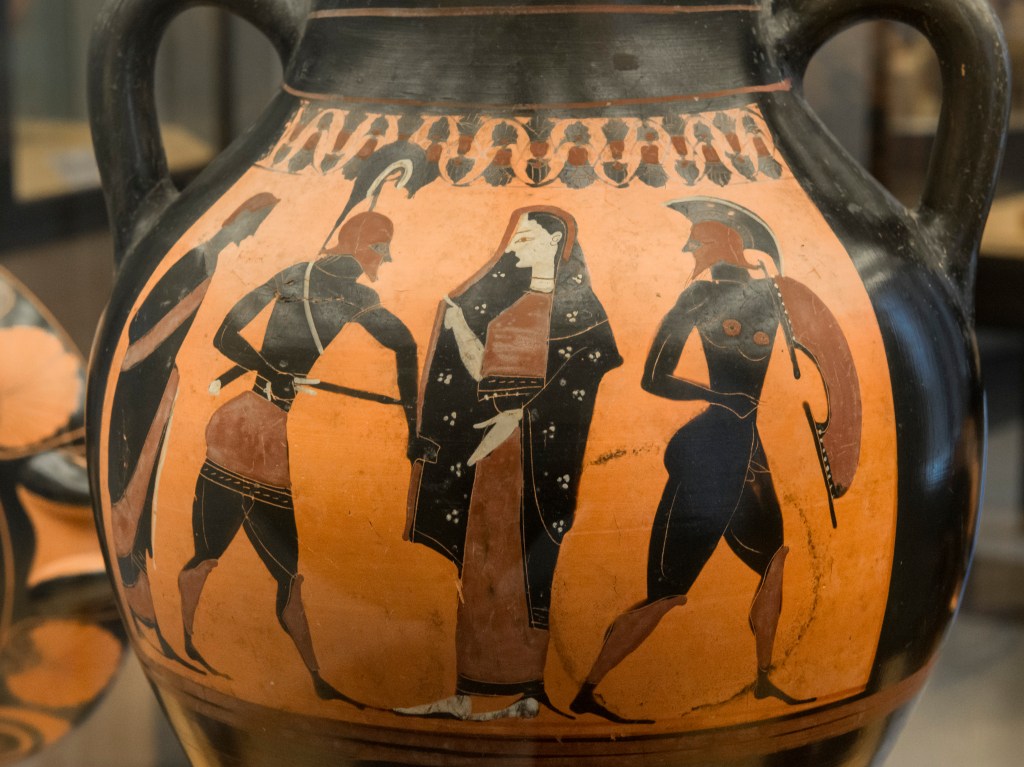
Description: This amphora describes the scene after Greek had conquered Troy. Menelaus was taking Helen back to Greek. The woman covering her head with a himation is Helen. She stands between two warriors. The one she is talking to is supposed to be Menelaus, the King of Sparta and the husband of Helen. The warrior on the right who carries a Boeotian shield might be another hero from the Greek, probably Agamemnon. Even though the war has ended, Agamemnon still holds his shield high up, representing the Greek warrior spirit stating that warriors should never loosen their minds. However, the reason for Menelaus to hold up his dagger might be different: First, it is possible that Menelaus may hate Helen for her betrayal, so he pretends to threaten her to teach her a lesson. Second, the blanket that Helen is wearing may be made in Troy. Menelaus hates the trojan so much that he wants everything from Troy to disappear. He wants to use his dagger to cut the blanket into pieces. His left hand grasping the blanket can be the best proof of this idea. That Helen’s one finger is pointing to Menelaus may mean that Helen is trying to persuade Menelaus not to do that. One mysterious part is about the man standing in the leftmost. Who is him? Why doesn’t he wear the armor? Why he wears in a different cloth style? I guess that can be a servant of Menelaus. However, his hands are putting in the back. Normally, putting the hands in front of the body means respect, while putting the hands backward means superiority. As a result, that can be someone else. If the Greek culture is different from my culture, that person may just be a servant. In the end, Helen and Menelaus enjoy the rest of their lives in the palace peacefully. 

图片包含 墙壁, 室内, 文字, 旧

描述已自动生成

Painter: Creator: Deshays de Colleville, Jean-Baptiste-Henri (French, 1729-1765)  Weaver: Charron, André-Charlemagne (French, fl.1754-1780)

Title: Venus intervenes in duel between Paris and Menelaus, Illiad, Set A

Work Type: Textiles – Tapestries

Date: 1761-1770 c.

Creation Location: Beauvais

Current Location: French Museum

Measurements: H 12′ x W 19’6″

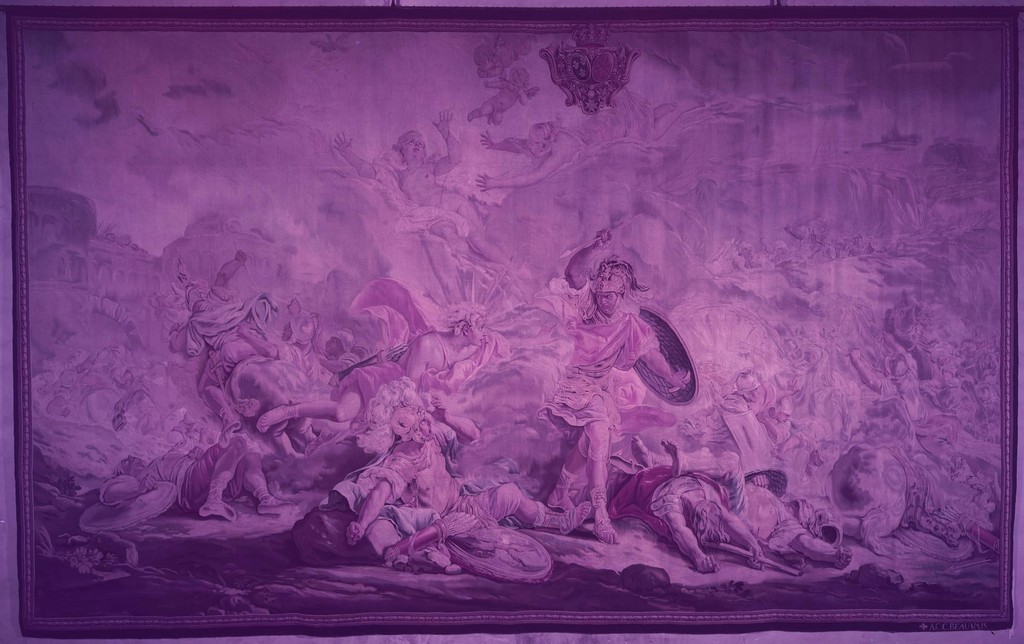
Description: Jean-Baptiste-Henri is a French professional painter who received systematic training in both Rome and France. He painted this before he went to Rome. The picture described the scene of the duel between Menelaus-the king of Sparta, and Paris-the trojan who took Helen from Menelaus. When Menelaus is about to kill Paris with his dagger, the Goddess of Love Aphrodite appears and saved Paris my hiding him behind the cloud and mist. The cloud blocks Menelaus’s sight and makes him lose the target. The Painter emphasizes the anger of Menelaus, as he portrays Menelaus’s face with ferocious facial expression, as all his facial features twisted closely. That Menelaus’s widely opened eyes directly stare at Aphrodite further intensify that anger, anger of missing the chance of killing Paris. On the other hand, Paris—beaten to the ground by Menelaus and lifting his arm to make it as the last defense—shows the fear toward the death and Menelaus through his intimidating face. Aphrodite clearly exposed her worry toward Paris, as she stretches out her hand trying to grasp Menelaus to stop him from killing Paris. Her panic eyes shows that she is restless. The author also tries to describes the war as brutal: he paints the warriors’ armor and clothes in red- the color of blood and the symbol of hotness. Furthermore, the few bodies lied around Menelaus and those fighters fighting behind further enhance the brutality of the war. One interesting thing is that I do not see the cloud that saves Paris life, as described in the book Illiad. Maybe that dime-blue wrinkled cloth around Aphrodite’s left hand is the cloud. There are also few gods flying in the sky; a scene doesn’t appear in the Illiad. It can be a symbolic meaning representing that many gods are involved in the Trojan War, or it can be the author’s imagination that diversifies the scene. Still, this duel is the most important one in Trojan war because it directly makes Greece decide to completely conquer Troy, as trojans break the promise of duel and cheated even though those trojans are manipulated by gods. The gods still control the human world, and Troy’s destruction is fate.

图片包含 室内, 舰, 餐桌, 墙壁

描述已自动生成

Title: Vase (amphora) with painted decoration.

Work Type: Ceramic / Antiquity

Date: Ca. 550–525 B.C.

Material: Terracotta (black-figured).

Period: GREEK / late VI–early V century B.C.

Size: Height: 59.3 cm. (23 3/8 in.).

Current place: The University Museum, Philadelphia

Scene: related to the Aithiopis, in which Menelaus is killing an Ethiopian warrior identified as “Amasos.”

图片包含 建筑物, 户外, 雕塑, 旧

描述已自动生成

Title:Menelaus with the Body of Patroclus; Roman copy of a Hellenistic original

Location: Loggia della Signoria (Florence, Italy)

Period: late classical

Work Type: Sculpture

Scene: Menelaus is carrying the body of Patroclus when the war ends.

Menelaus’s Bibliography

Sammons, B. (2009). BROTHERS IN THE NIGHT: AGAMEMNON & MENELAUS IN. BOOK10. OF THE ILIAD. Classical Bulletin85(1), 27–47.

This article explores the role of Menelaus in the Trojan War, while also analyzing the interaction and relationship between Agamemnon and Menelaus. It suggested that Menelaus is more like a moral figurehead of the Achaean expedition, while Agamemnon acts as an army commander in chief. Specifically, after Menelaus has convinced Agamemnon to conquer Troy, he seems to cede all authority over the expedition to his brother. He is not a member of Agamemnon’s inner council of foremost heroes, including Ajax and Diomedes. He also never speaks in the assembly where Agamemnon exercises his authority publicly. They seem to have no interaction. However, book 10 of the Iliad, according to the author, indicates that there are interactions that reveal the relationship between Agamemnon and Menelaus. First, that Menelaus wears a leopard skin while Agamemnon wears a lion skin shows that Menelaus is inferior to Agamemnon. Second, when both Agamemnon and Menelaus showed the feeling of terrified toward the conquer of the Troy, Nestor blamed Menelaus as a coward while praising Agamemnon as a wise man who considers every situation possible. It further indicates the inferiority of Menelaus. I realize that the role of Menelaus in the Trojan War is manipulated by Agamemnon instead of by Menelaus his own. Because Menelaus has already become a victim whose wife has been robbed by others, Agamemnon wants to use this characteristic of Menelaus as a tool to raise other heroes’ resentments and morale. It is similar to such a situation: by portraying a beggar as vulnerable and helpless, everyone will have sympathy toward him and is willing to help the beggar. This is the reason why Agamemnon delivers a lament speech to the public after seeing that Menelaus has been shot by Pandarus, a trojan. In order to maintain Menelaus’s identity as a victim, Agamemnon tries to push Menelaus back every time he wants to fight. Besides, through the conflict between Agamemnon and Achilles, we can know that Agamemnon is a person who favors absolute power. Consequently, Agamemnon will not allow Menelaus, his brother, to have the same status as him. The absence of Menelaus in most scenes is not because Menelaus is a coward, but because he is forced to be shaped as a coward by Agamemnon. This article is significant because it explores deeply into the Agamemnon-and-Menelaus relationship that the book Iliad does not obviously state. It also explains the role of Menelaus plays in the Trojan War. I realize that the bond between the brothers in that society is not that friendly and tight as I think. Besides, the warrior code that focuses on honor manipulates everyone’s behaviors at that time.

Stelow, A. (2003). The “Aristeia” of Menelaos. The Classical Journal104(3), 193–205. published in March.2009
This article mainly tries to fully explain the role and character of Menelaus in book 17 of Iliad, in which Menelaus tries to defend Patroclus’s corpse at any cost. Menelaus is the first man noticing the death of Patroclus. As soon as he discovered it, he killed all the enemies who want to take Patroclus’s body, while asking Antilochos to bring news of Patroclus’s death to Achilles. Menelaus decides to return to the war zone instead of going with Antilochos. According to the article, Menelaus does this because of sympathy instead of glory, as Menelaus says the words like ”painful message” and the book 17 described him as ”reluctant to leave.” Why homer singled out Menelaus for such extraordinary prominence? According to the author, there are two theories explaining this. The first explanation is that Menelaus is the only choice because other heroes, such as Ajax and Odyssey, are wounded. However, this does not explain why Aias is not chosen. The second explanation is because Patroclus and Menelaus are similarly gentle. Nevertheless, it fails to explain the central role played by Menelaus in this pivotal area. There is also an explanation saying that the ancient author likes to draw similar motifs from other poems: that Patroclus’s body is defended by Menelaus and Aias is similar to Achilles’s body is defended by Odyssey and Ajax in Aithiopis; It is a mere focus of certain character. All of these, according to the article, does not address the problem. In the author’s opinion, ”Menelaus fulfills a pivotal function in mediating the two major themes of the poem: Achilles’s wrath and the Trojan War. Menelaus is the central cause of this war and has an overriding concern about the prosecution of the war. However, Achilles has no reason to join this war previously until the death of Patroclus. By letting Menelaus defending the corpse of Patroclus, Homer draw Menelaus into Achilles’s story. That Menelaus decisively defend the corpse plants the seed of Achilles’s decision to join the war. Two heroes who have different motives are now struggling toward the same outcome: conquering the Troy. The article is unique because it tells me that the chosen of Menelaus is not a random selection; it has its purpose, which is connecting two main themes of the Iliad. In addition, the article clarifies that protecting ally’s corpse is exceptionally important, and that Patroclus’s body is defended by many heroes with high cost is one of the few unique cases. It explores one scene that one usually doesn’t care too much about, with innovative and persuasive reasons.

Olson, S. (1989). The Stories of Helen and Menelaus (Odyssey 4.240-89) and the Return.of Odysseus. The American Journal of Philology110(3), 387–394.

This article lists two stories relating to spying the troy told by Helen and Menelaus during a dinner party. The two stories have the same characters, Odysseus and Helen, but have distinct contents. According to Helen’s story: Helen helps Odysseus hide his identity after she discovers him in city Troy. Helen fights for the Greeks even she is in Troy alone. However, according to Menelaus: Helen fights against the Argives till the end of troy with the accompany of her Trojan lover Deiphobus. He describes Odysseus as a powerful and intelligent man who can control the people around him. When Menelaus cannot address himself after seeing his wife Helen, Odysseus helps him. These two stories are not merely the stories; they are self-justification and self-explanation. For Helen, she thinks that she does not do anything wrong and is always loving the Greek. She wants to clarify herself as a just and loyal woman. However, because Menelaus has experienced betrayal from Helen, he described Helen as an evil character in the story as a way to indicate his dissatisfaction and anger. He emphasizes his miss toward Helen by mentioning that ”Menelaus cannot address himself in the presence of Helen. ” Besides, Menelaus describes the idealized male character in the society at that time: being powerful, calm, and intelligent. It shows Menelaus’s respect toward a person like Odysseus. When talking about whether disguised Odysseus has exposed his real identity to his wife Penelope, Helen and Menelaus’s answers are also different: while Helen says that Odysseus does expose his identity, Menelaus says that Odysseus hides the identity all the times and faces the enemies alone. It reflects Menelaus’s, or even all society’s male’s, one core value: the wife-husband bond is not that reliable and solid comparing to the father-son bond, as Menelaus’s Odysseus is afraid that his wife will betray him even Penelope is faithful to Odysseus. ” It is not just the security of the individual, but that of collective male society as a whole and the values it supports that depends on the active suppression of the husband’s instinctive desire to share his secrets with his wife.” This means that every husband has the desire to tell his wife every secret he has. By limiting this desire, every husband will make society more secure with accumulated effort. Obviously, it reflects the male-dominant culture in which females should never interfere with or understand a male’s mission. It is a typical form of heroism which states that a powerful man should handle every difficulty on his own.

Cilliers, L. (1991). Menelaus’ “unnecessary baseness of character” in Euripides’ “Orestes.” Acta Classica34. Retrieved from http://search.proquest.com/docview/1298193440/

KYRIAKOU, P. (1998). MENELAUS AND PELOPS IN EUR IPIDES’ ORESTES. MNEMOSYNE, 51(3), 282–301. HTTPS://DOI.ORG/10.1163/1568525982611452

SAMMONS, B. (2014). THE QUARREL OF AGAMEMNON & MENELAUS. MNEMOSYNE, 67(1), 1–27. HTTPS://DOI.ORG/10.1163/1568525X-12341212

Menelaus’s Biography

Menelaus is the son of Atreus who is the king of Greek, the younger brother of Agamemnon who is the high king of the Mycenae, and the younger brother of Anaxibia. Menelaus exiled from Mycenae when Atreus was killed by his brother Thyestes’s son Aegisthus and when Thyestes became the king of Mycenae. Menelaus is also the husband of Helen: When so many suitors from different places wanted to marry the gorgeous Helen, one suitor called Odysseus suggested Tyndareus—the king of Sparta—using the method of throwing ring to decide which person would marry Helen. The handsome Menelaus was chosen. Then with the aid of Tyndareus, Menelaus went back to Mycenae and drove its hostile ruler Thyestes to an island called Cythera. Menelaus later officially married Helen and became the king of Sparta after the death of Tyndareus based upon the law. 

       “Ten years later, Menelaus received Paris—a handsome Trojan and the brother of brave warrior Hector— as a guest in his palace. However, Menelaus had to sail to Crete in order to attend the funeral of Catreus, who is the mother of Menelaus’s father, Atreus. “Paris and Helen then became lovers due to the absence of Menelaus. They then sailed back to Troy together and left little Hermione— 9-year-old daughter of Menelaus—alone.

  After realizing the betray of his wife when he came back, Menelaus was angry. He convinced Agamemnon to wage war toward Troy at any cost, even including sacrificing Agamemnon’s daughter Iphigenia to Artemis. Because those suitors of Helen once achieved an agreement that they will protect and help Helen’s husband as much as they can, Menelaus gathered lots of powerful allies. However, Menelaus had the last peaceful try: he went to Troy together with Odysseus and tried to claim Helen back. Though being hospitably treated by a Trojan elder called Antenor, Menelaus did not achieve his purpose. A Trojan called Antimachus insisted that Helen should stay at Troy with Paris; He even suggested the Trojan citizens killing Menelaus and Odysseus.

       Menelaus was now in a fury. The ten-year-long Trojan War started. Menelaus killed thousands of Trojan together with Agamemnon and other strong warriors. They almost overwhelmed Trojans. In the middle of the Trojan War, both sides agreed that Menelaus and Paris would have a duel to solve the problem related to Helen. As a result, they set up a temporary truce and agreed that nobody should hurt the enemy during the duel. When the duel began, Paris lost his chance to kill Menelaus as he hit Menelaus’s pauldron. In Menelaus’s turn, as soon as he was stabbing his spear into Paris helmet, the god of love Aphrodite quickly saved Paris by pulling Paris out, hiding him in the mist, and returning to the Troy. Hera, the god who favor the Greek, made a Trojan warrior called Pandarus break the truce by guiding him to shoot at Menelaus. Menelaus was shallowly wounded and was later healed by Machaon. The war then started again. 

       This time, more gods were involved in the war. When Ares, the god of war who favors Trojans, noticed that Trojans could not handle the force from Greek, he came down from Olympus to fight against Greeks. Apollo saved a warrior called Athena by bringing him to Apollo’s sanction and healing him. Pallas Athena, a more powerful god who favors Greeks, on the other hand, came down to help a Greek warrior called Diomedes when he could not fight with Ares.

        The battle lasted for years.

       When the Trojans were finally defeated, and when Menelaus’s force finally reached the house where Deiphobus has married Helen after the death of Paris, Menelaus arrested Deiphobus and cut him into pieces brutally. Menelaus finally got his wife, Helen. When Menelaus met Proteus, a seer knowing everything, in Egypt, he heard that he had offended the gods by sacking Troy. Consequently, he wandered around the Mediterranean areas for eight years in order to appease the god. Then he finally brought Helen back to home. 

Menelaus and Helen led a pleasant life in their palace for the rest of their lives. When Menelaus died, the god Hara made him immortal.

Reference

Leiden, B(2005), Menelaus, Brill’s new Pauly.

Parada, C(1997), Menelaus, General Guide to Greek Mythology Characters,http://www.maicar.com/GML/index.html

Spawforth, A., Eidinow, E., & Hornblower, S. (n.d.). The Oxford classical dictionary(4th ed. / general editors, Simon Hornblower and Antony Spawforth assistant editor, Esther Eidinow.). Oxford: Oxford University Press.

Smith, W(1870), Menelaus, ENCYCLOPEDIA MYTHICA, Dictionary of Greek and Roman Biography and Mythology,  https://pantheon.org/articles/m/menelaus.html